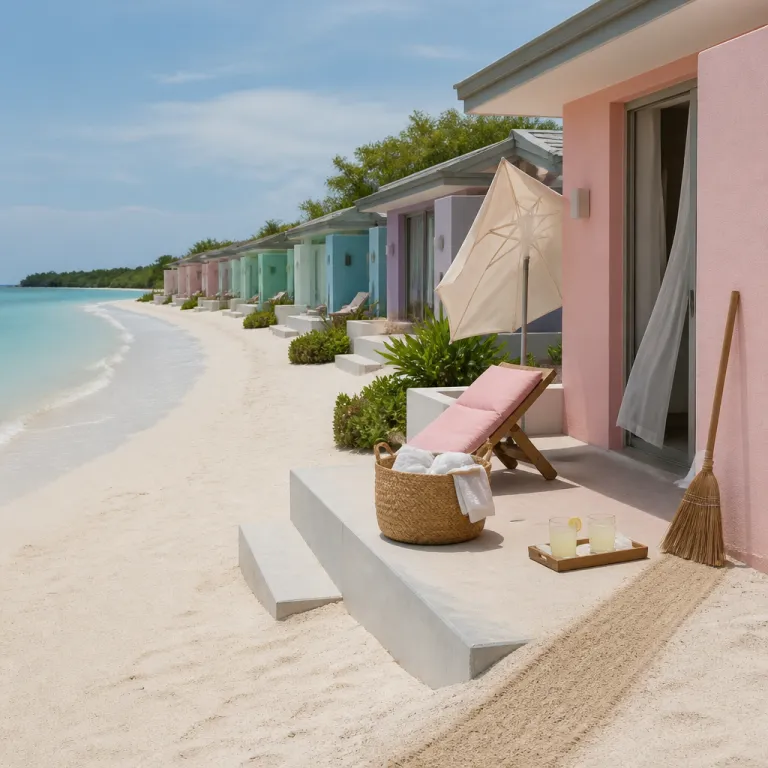
Where seclusion becomes the service, not the slogan
At the furthest end of the private island resort spectrum, a handful of properties treat seclusion as their primary amenity. These are the hideaways where guest numbers stay in single digits, staff outnumber guests, and the entire island can be reserved by one family or group seeking absolute privacy. For travelers used to large luxury resorts, the shift from 100 keys to nine villas or fewer completely changes how you move, dine, and even walk along the beach.
Here Maldives, operated by Here Maldives as a resort operator, sits in the Baa Atoll on a privately leased island and it embodies this new definition of private. Publicly available resort information describes a collection of just nine villas with generous indoor–outdoor living spaces and expansive decks, and a starting nightly rate that typically runs into the low five figures in US dollars for peak periods. It is designed for guests who see a private island as a sanctuary rather than a spectacle, with private yachts, dedicated butlers, and luxury villas that turn the surrounding sea into your only real neighbor.
Families booking this level of exclusive island retreat are not chasing the usual Caribbean party scene or crowded bay island strips. They want a beach resort where children can run the length of the sand without meeting anyone outside their own group, and where early check in or a late departure is handled quietly because there is no next guest waiting for the same villa. In this world, the best luxury is measured less by marble and more by how rarely you see another sun lounger on the beach.
The seclusion spectrum, from low density to full island buy out
Ultra exclusive island resorts sit on a spectrum that starts with low density luxury resorts and ends with full private island buy outs. At one end, you find beach properties with 30 to 50 keys, generous spacing between villas, and a sense of calm that still allows for social interaction at the sea facing pool or bar. At the other, you have islands like Here Maldives or Laucala Island, where a single booking can turn the entire island into your family’s private playground.
In the middle of this spectrum are places such as Kokomo Private Island Fiji, North Island in the Seychelles, and Mnemba Island off Zanzibar, each a private island resort that balances privacy with a light social buzz. These retreats usually offer between 10 and 30 villas, with long stretches of beach reserved for only a few guests at a time, and they often provide options for early check in or a late check out to match private jet schedules. For many families, this tier of private island beach resort luxury delivers the best mix of privacy, service, and value, especially when compared with the cost of a full island buy out.
At the very top, full buy out islands such as Cayo Espanto in Belize, Islas Secas in Panama, and Ambergris Cay in Turks and Caicos cater to groups who want total control over who shares their sea views. These islands often market themselves as the best luxury solution for multigenerational trips, executive retreats, or celebrity travel, because every villa, every stretch of beach, and every cay style sandbar belongs to one party. If you are curious how to access more attainable seclusion, guides to private island resorts that cost less than you think can help you benchmark rates before committing to a full buy out.
Inside Here Maldives: nine villas, one island, infinite quiet
Here Maldives in Baa Atoll is a case study in how a private island resort can reset expectations for privacy. The island holds only nine villas, yet each residence feels like its own sea facing compound, with private pools, personal chefs, and spa services forming the core amenities. According to the resort’s own information, private pools, personal chefs, and spa services sit alongside tailored excursions and wellness programs designed for small groups.
The Presidential Residence is described by the resort as spanning more than 2,400 square metres, and the entire island can be booked as a private island for one group, which turns the staff to guest ratio on its head. Guests typically arrive by seaplane from Malé or by private yacht, stepping directly from the sea onto sand that will be shared with only a handful of other travelers, or no one at all if they opt for exclusive access. For families, the resort is explicitly family friendly, with tailored activities for all ages that make the island feel like a safe, contained world where children can explore without constant supervision.
Rates at this level of private island beach resort luxury are unapologetically high, reflecting both the scarcity of villas and the cost of operating in such isolation. As a broad reference point, similar nine villa islands in the Maldives often start around US$6,000 to US$10,000 per night for smaller residences and rise sharply for multi bedroom estates and full island buy outs. Prospective guests should book well in advance, prepare for high costs, and arrange private transfers that align with early check in or late check out options. For a broader view of how Here Maldives compares with other island resorts in the region, consult a detailed Maldives atoll guide such as a resort by resort overview of every atoll, which helps you understand what you gain when you trade a larger resort for a nine villa island.
How ultra private islands work for families, not only for honeymoons
Many travelers still associate a private island with honeymoons, yet the reality on the ground is that HNW families now dominate bookings at the most exclusive island resorts. Parents choose these islands because the contained geography, limited villas, and high staff presence create a natural safety net for children, especially on a beach where there are no passing crowds. In practice, a private island beach resort can feel more relaxed for families than a large Caribbean hotel, because you are not constantly scanning the sea of strangers around the pool.
Properties such as Jumby Bay in Antigua, Parrot Cay and Ambergris Cay in Turks and Caicos, and COMO Parrot Cay under the COMO Hotels and Resorts umbrella have leaned into this shift. They offer multi bedroom villas, kids’ clubs, and family focused experiences that still respect the core promise of privacy, from quiet sea island picnics to guided reef explorations where your group is the only one in the water. One repeat guest described the appeal simply: “By the second day, we knew every face on the island, and our kids could wander between the beach and the villa without us worrying.” Even at the most rarefied luxury hotels, early check in and late departures are increasingly structured around family flight patterns, private jet arrivals, and the reality that younger guests do not wait well in lobbies.
For American families planning luxury travel, the key is to match the island’s level of seclusion with your children’s ages and interests. A nine villa island resort like Here Maldives or Mnemba Island offers intense quiet that suits older children who enjoy snorkeling, reading, and long beach walks, while a slightly larger beach resort such as Jumby Bay or Laucala Island may provide more structured activities. If you want a taste of this privacy focused style without committing to a full private island, consider low density properties such as the refined coastal stays reviewed at Buye Beach Resort in Cabo Rojo, which borrow some of the same principles on a more accessible scale.
Logistics, limitations, and what you really pay for
Booking a private island beach resort luxury exclusive stay is as much a logistical project as a travel dream, especially when the island sits far from major medical facilities. Transfers often involve a combination of commercial flights, private jets, seaplanes, helicopters, and private boats, and each step must align with the resort’s early check in or late check out policies. Families should factor in not only the nightly rate but also the cost and duration of these transfers, which can easily add several thousand dollars and many hours of travel time, particularly when journeying with young children or older relatives.
Connectivity is another trade off that defines these islands, because the same remoteness that guarantees privacy can limit mobile coverage and internet speeds. On some islands, such as Islas Secas or sea island style properties in more remote archipelagos, you may find that the best luxury is the enforced digital detox, while others like COMO branded resorts in Turks and Caicos or Caribbean cay destinations maintain stronger links for guests who need to work. Before you commit, ask the resort for precise data on medical proximity, evacuation protocols, and how they handle emergencies when the sea turns rough or a storm cuts standard routes; many high end islands maintain agreements with nearby clinics or hospitals and can arrange boat or helicopter transfers within one to two hours when conditions allow.
Ultimately, what you pay for at these island resorts is not only the villa, the beach, or the sea views, but the right to control who shares them with you. A private island stay means your children’s footprints may be the only ones on the sand at sunrise, and your family may be the only guests at dinner under the stars. For travelers who value privacy above all, that is the essence of a private island beach resort luxury exclusive stay, whether they choose a nine villa hideaway, a low density bay island retreat, or one of the world’s most remote luxury hotels.
FAQ
How far in advance should I book an ultra private island resort ?
For a true private island or very small island resort, you should book at least several months in advance, and a year ahead for peak holiday periods. Properties with only a handful of villas, such as Here Maldives or Mnemba Island, have extremely limited availability, especially for full island buy outs. Early planning also gives you more flexibility on villa selection, transfer timings, and options for early check in or a late departure.
Are ultra private island resorts suitable for families with young children ?
Many private island resorts are explicitly family friendly and offer tailored activities for all ages, from supervised beach play to gentle sea excursions. The contained nature of an island, combined with high staff to guest ratios, can make these environments feel safer and more manageable than large resorts. Always confirm childcare options, pool safety measures, and medical access before booking, especially when traveling with infants or toddlers.
What amenities can I expect at a nine villa private island resort ?
At this level, you can expect private pools, personal chefs, spa services, and highly personalized itineraries built around your family’s preferences. Many island resorts also provide private yachts or boats, dedicated butlers, and flexible dining that allows you to eat anywhere on the island, from the main restaurant to a secluded beach. The emphasis is on privacy and customization rather than a long list of shared facilities.
How do transfer logistics work for remote private islands ?
Most ultra private islands require a combination of international flights and onward transfers by seaplane, helicopter, or private boat arranged through the resort. You will receive a detailed schedule once your flights are confirmed, and the resort will coordinate timings to minimize waiting, sometimes offering early check in if your villa is ready. Always budget extra time for weather related delays, especially in regions where sea conditions can change quickly.
What is the main difference between a low density beach resort and a full private island ?
A low density beach resort typically has more keys and shared spaces, so you enjoy space and calm but still encounter other guests around the pool, restaurants, and beach. A full private island, by contrast, can be reserved entirely by one group, which means every villa, every stretch of sand, and every activity is exclusive to your party. The choice comes down to how much privacy you require, how social you want your stay to feel, and how much you are prepared to invest in that level of seclusion.