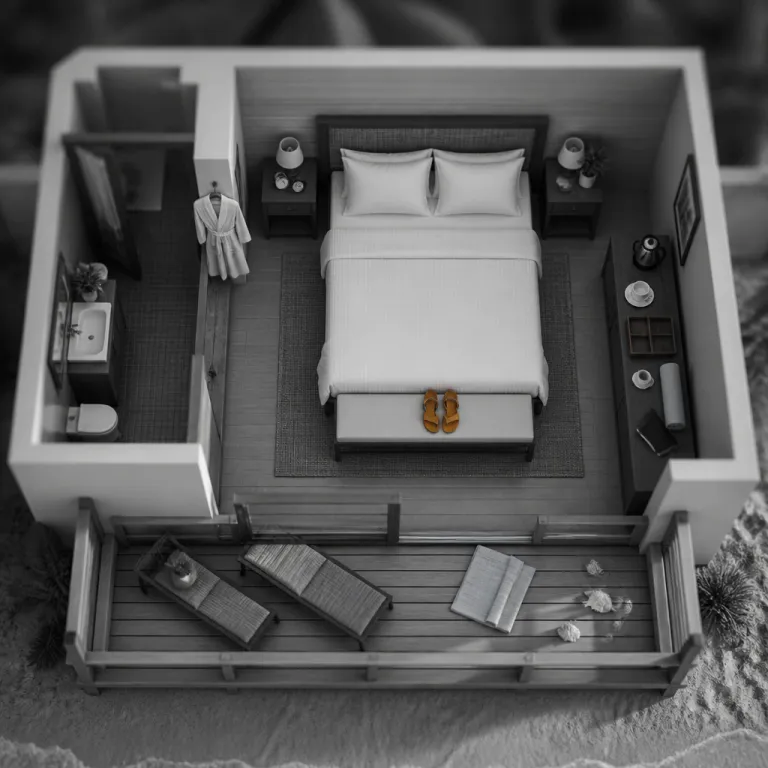
The new luxury beach resort room design experience
The real luxury beach resort room design experience starts when you wake and register the light on the ceiling. Then you notice how the room frames the first view of the beach, the island horizon, and the exact way the curtains fall around that rectangle of sky. In the best coastal rooms, every line, texture, and switch has been shaped around how you actually live through each night and day, not how the space performs in a single hero shot.
Hospitality research now shows that aesthetic and functional designs enhance comfort and satisfaction, and that guest satisfaction increases by 15 % when room design is improved. Another study confirms that the percentage of guests influenced by room aesthetics reaches 80 %, which explains why serious resorts treat rooms as the core of their identity. This is the quiet revolution behind your next stay at a luxury hotel on a private island or a stretch of southern California coast.
Designers talk about restorative luxury and neuro aesthetic calm, but you feel it as soon as you check into your room. The palette is sun kissed rather than saturated, with coastal tones that echo the clear lagoons or the deeper blues off Laguna Beach. Furniture is scaled so you can move easily from bed to terrace to spa inspired bathroom, creating a seamless luxury beach rhythm that makes the whole resort feel more intuitive.
For couples planning dates around a special anniversary or a long awaited escape, this shift matters. You are no longer choosing between anonymous rooms in interchangeable hotels resorts ; you are choosing how you want to wake, work a little, and sleep beside the ocean. The most thoughtful beach resorts now brief their interior designers with survey données and interview insights, then test layouts with real hotel guests before rolling them out across entire villas and private villas.
That research led to three clear priorities for the modern design of coastal rooms. First, layouts must support both connection and privacy, especially in family friendly resorts where a kids club sits just a few metres from quiet couples’ suites. Second, materials and art should root each beach resort in its local community, rather than copying a generic luxury hotel template. Third, discreet smart technology should simplify the stay beach experience without turning your oceanfront luxury retreat into a blinking control panel.
Restorative luxury and neuro aesthetic calm in coastal rooms
Restorative luxury is the design philosophy that treats your room as a reset space, not a stage. In practice, that means fewer decorative objects, more tactile materials, and a choreography of light that shifts from bright coastal clarity by day to soft, warm pools at night. Neuro aesthetic calm goes further, using colour, proportion, and even sound absorption to lower your heart rate the moment you step in from the beach.
In the Maldives, for example, leading resorts now commission interior designers to map how guests move between private pools, plunge pools, and the bed across a typical twenty four hour cycle. The goal is to ensure that every transition feels effortless, whether you are returning from the spa, a late swim in clear lagoons, or a sunset walk along the beach. Similar thinking is reshaping rooms in southern California, where oceanfront luxury properties near Laguna Beach are softening acoustics so that the only soundtrack is the tide, not the corridor.
These spaces are still unmistakably luxury, but the expression has changed. Instead of glossy surfaces that reflect every downlight, you see matte stone, woven grasscloth, and timber that has been brushed, not lacquered, to echo the coastal landscape outside. Our in depth guide to interior design choices that make a beach resort feel real explores how this shift away from clichés creates a more grounded luxury beach atmosphere.
For couples, this new luxury beach resort room design experience translates into a more intimate, less performative stay. You can leave the terrace doors open at night without feeling exposed, thanks to layered sheers and smart louvres that protect privacy while framing the view. You can also move from a freestanding tub with an oceanfront luxury panorama to a private plunge on the deck without ever crossing a public path.
Resort management teams now work closely with hospitality institutes and design firms to test how these choices affect real behaviour. Surveys, interviews, and on site observations reveal that guests linger longer in rooms that feel like calm coastal sanctuaries, even when the resort offers extensive activities and a lively community scene. That extra time in the room often translates into higher satisfaction scores, stronger loyalty, and more positive reviews for hotels and resorts competing across global beach destinations.
The indoor outdoor threshold: where rooms meet the shoreline
The most memorable luxury beach resort room design experience usually hinges on a single threshold. It might be the sliding wall that opens your suite to a private deck, or the pivot door that separates a cool bedroom from a sun kissed outdoor shower. However it is engineered, that line between inside and outside now defines how you relate to the beach, the resort, and the wider coastal environment.
At high end beach resorts in the Maldives, overwater villas use retractable glass to erase the barrier between bed and lagoon, while still allowing you to close everything at night for comfort and security. Many of these villas now feature private pools or compact plunge pools that sit just above clear lagoons, so you can check the reef conditions without leaving your deck. On a different latitude, southern California resorts near Laguna Beach are experimenting with corner rooms that open to two exposures, capturing both sunrise and sunset along the same stretch of coast.
Couples choosing dates for a romantic escape should look closely at how each resort handles this indoor outdoor seam. Some hotels offer private villas with outdoor living rooms, where ceiling fans, shade structures, and soft textiles extend the usable hours of the day. Others focus on compact but brilliantly planned rooms, where a single sliding panel reveals an oceanfront luxury terrace just large enough for two chairs, a table, and a private plunge pool.
Biophilic thinking, which connects interiors more directly with nature, is now central to this evolution of coastal rooms. Our feature on nature first architecture in luxury coastal stays explains how architects and interior designers collaborate to align openings with breezes, tides, and sun paths. When this is done well, you wake to a cross current of air, filtered light, and the low sound of waves, rather than the hum of air conditioning alone.
From a service perspective, the indoor outdoor threshold also changes how staff interact with your space. Housekeeping teams are trained to manage sand, salt, and humidity so that rooms remain crisp even when guests stay beach side for most of the day. Spa therapists may offer in room treatments on terraces, turning private decks into open air wellness suites that feel more connected to the resort’s coastal setting than any enclosed spa cabin.
Materials, bathrooms, and the hidden work rest balance
Material choices are where a luxury beach resort room design experience either feels rooted in place or strangely placeless. When you run your hand along a headboard carved by a local artisan, or step onto stone quarried from nearby cliffs, the room starts to belong to that specific beach. This is what design firms and groups such as DLR Group describe as cultural stewardship, where interiors support the surrounding community instead of erasing it.
In practice, that might mean woven textiles dyed with coastal plant pigments in a Maldives resort, or reclaimed timber from historic piers in a southern California hotel. It can also show up in ceramics fired by village workshops, used for carafes beside the bed or bowls in spa style bathrooms. These details are subtle, but they differentiate hotels resorts that invest in their community from resorts that simply import a global luxury template.
The bathroom has quietly become the most important reset space in many beach resorts. Freestanding tubs are now oriented toward the best slice of view, whether that is a quiet cove on a private island or the open Pacific off Laguna Beach. Rainfall showers are often positioned near skylights or pocket gardens, so you can feel the coastal climate even when you are enclosed.
At the same time, the work rest tension has not disappeared, especially for guests who blend business and leisure on longer dates. The smartest rooms hide desks within cabinets, integrate power into bedside tables, and route strong WiFi through discreet access points, so the space still reads as a sanctuary. When you close the laptop, the room reverts instantly to a luxury beach retreat, not a satellite office with a better view.
For couples comparing resorts, it pays to learn how each property balances these competing needs. Some hotels emphasise spa like bathrooms and generous dressing areas, ideal for long nights out and slow mornings in, while others prioritise compact efficiency for guests who spend most hours on the beach or at the kids club. Either way, the most successful coastal rooms are those where every material, fixture, and hidden cable has been considered through the lens of how you will actually live in the space.
Booking smart: how to read room design before you arrive
Choosing the right luxury beach resort room design experience starts long before you step onto the sand. When you scroll through photos and floor plans, you are effectively reading the resort’s priorities in how it allocates space, light, and privacy. A little method, borrowed from the research tools used by hospitality institutes, can help you check whether a room will match the way you and your partner like to travel.
Begin by looking at the relationship between bed, seating, and terrace in both rooms and villas. If every image focuses on the pool or the lobby, ask for more detailed shots of the actual room, including the bathroom and any private outdoor areas. Pay attention to whether private pools or plunge pools are genuinely secluded, or whether they sit close to paths used by the wider community of guests.
Next, examine how the resort talks about its coastal setting and local culture. Properties that reference community partnerships, artisan collaborations, or cultural stewardship are more likely to offer rooms that feel specific to their beach, whether that is a private island in the Maldives or a headland near Laguna Beach. Cross reference this with independent reviews that mention room comfort at night, sound insulation, and the quality of spa bathrooms, not just the main resort pool.
Many luxury hotel websites now allow you to filter by room type, view, and access to features such as a kids club or spa. Use these tools to align your dates with quieter periods if you value calm, or with school holidays if you want a more family friendly atmosphere. Some resorts also offer a discreet promo code for longer stays, which can make a higher category of oceanfront luxury room or private villas more accessible.
Finally, remember that the room you wake up in will shape how you remember the entire resort. A thoughtful stay beach design, with clear lagoons or rolling surf framed just so, can turn simple routines into rituals you carry home. When you learn to read these design cues before you book, you move from choosing generic hotels and resorts to curating a personal map of coastal rooms that genuinely match the way you want to live by the sea.
FAQ
How does room design affect guest satisfaction in beach resorts ?
Room design affects guest satisfaction by shaping both comfort and emotion throughout the stay. Studies in hospitality show that aesthetic and functional designs enhance comfort and satisfaction, and that improved layouts can raise satisfaction scores significantly. In beach resorts, elements such as view framing, indoor outdoor flow, and spa style bathrooms often matter more than lobby grandeur.
What are the current trends in luxury beach resort room design ?
Current trends focus on restorative luxury, neuro aesthetic calm, and stronger connections to the surrounding coastline. Designers favour natural materials, biophilic elements, and flexible layouts that support both work and rest without visual clutter. Smart technology is integrated discreetly, while private pools, plunge pools, and outdoor showers extend the living space toward the beach.
Why is room layout so important in coastal resorts ?
Room layout determines how easily you move between sleeping, bathing, relaxing, and stepping out to the beach. A well planned layout can make compact rooms feel generous, protect privacy on private terraces, and frame the best possible view from the bed. Poor layouts, by contrast, can waste prime oceanfront positions and undermine even the most luxurious finishes.
How can I evaluate a resort room before booking my stay ?
You can evaluate a resort room by studying floor plans, photo angles, and independent guest reviews that mention specific details. Look for images that show the full room, bathroom, and any private outdoor areas, not just the main pool or lobby. When possible, contact the resort directly to check orientation, noise exposure, and whether features such as private plunge pools are genuinely secluded.
Are private pools and plunge pools worth the premium for couples ?
Private pools and plunge pools can be worth the premium if you value privacy, spontaneous swims, and quiet time together. For many couples, these features turn the room into a complete retreat, reducing the need to share crowded main pools or busy beach areas. The value is highest when the pool is well oriented for light, sheltered from wind, and offers a strong connection to the surrounding coastal landscape.
Sources
Hospitality Design Journal ; Hotel Management Survey ; DLR Group hospitality trends reports.